
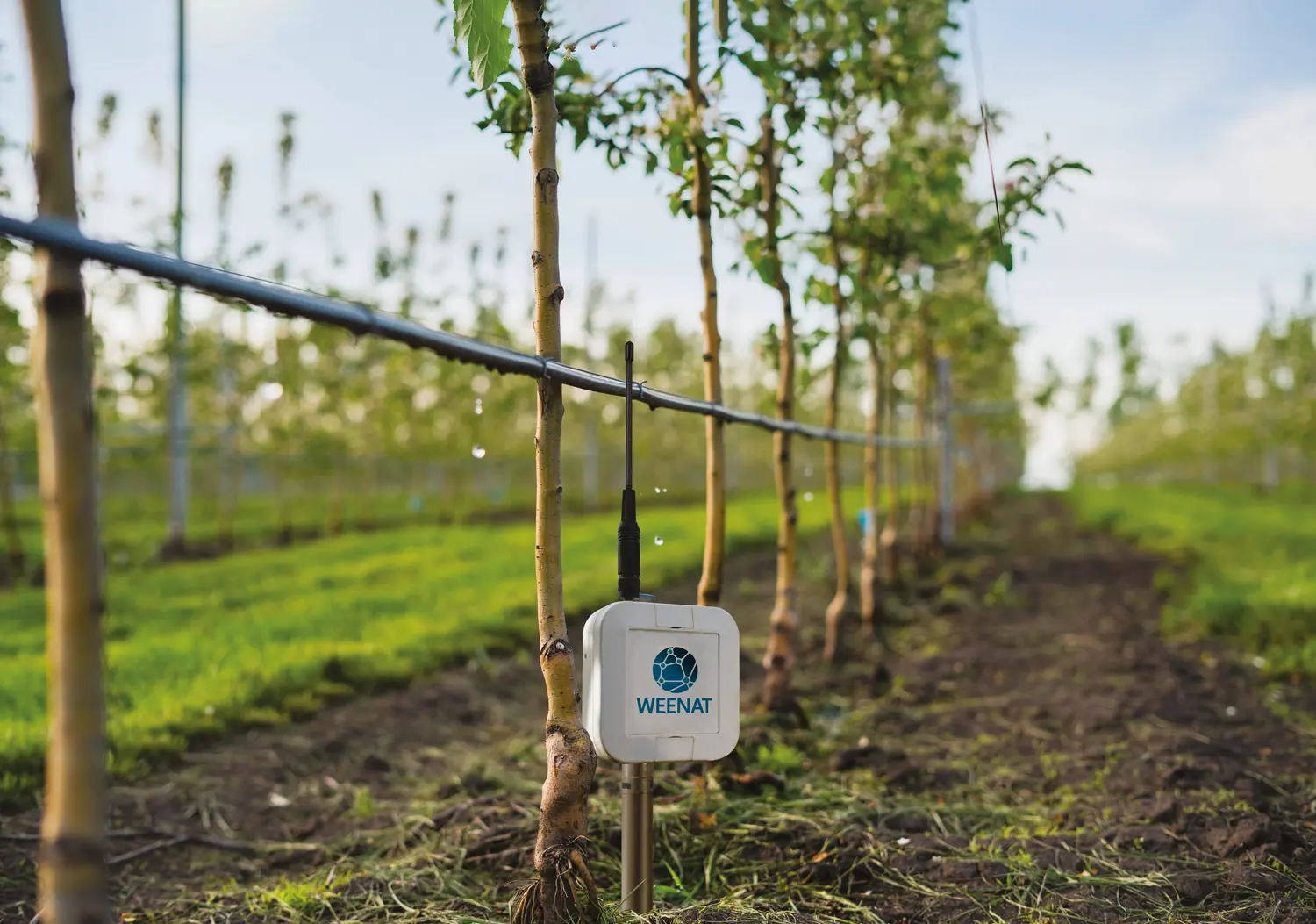
A tensiometric probe to irrigate your crops when they really need it
No more “wet finger” irrigation. Thanks to Weenat tensiometric probes, you monitor the water status and soil temperature in real time.
Result? You know exactly when to start or stop irrigation. You save water. And you make better decisions.
Free quote request with no obligation


ROBUST. PRECISE. MAINTAINABLE.
The reference probe for managing your irrigation
Whether it rains, freezes, or there’s drought, your Weenat tensiometers are out there. Busy measuring what’s happening in your soils. So we wanted sturdy materials. For precision that lasts, even after years.
Tensiometer measurements
Three depths
The probes are sold in packs of 6 to measure soil water status at different depths. They come in 3 sizes: 30cm | 60cm | 90cm.
| Measurement | Unit | Measurement principle | Measurement range |
| Tensiometry | kPa | Electrical resistance | 0 to 200 kPa |
| Soil temperature | °C | Transistor thermometry | -40 to +60°C |
Tensiometry measurement
Weenat tensiometers mimic root function. They’re equipped with a Watermark sensor capable of precisely measuring the force (in kPa) that roots must exert to extract water from the soil.
Temperature probe
Each Weenat tensiometer is equipped with a probe to monitor soil temperature (± 0.5°C).
Data transmission to the Weenat application
Sensor data is transmitted in near real-time via low-power Sigfox, LoRa, or LTE-M NB-IoT (4G/5G) networks, which are energy-efficient.
High-quality material
Resistant battery
The Weenat tensiometric probe works wirelessly. Instead, you’ll find an ultra-resistant battery with a minimum 2-year autonomy. When it’s empty, your battery can be changed without technician intervention.
316L stainless steel base
It’s a low-carbon steel to prevent corrosion. It’s very solid and completely rust-proof. So rest assured that your sensor will still be standing, even in 50 years.
Other features
| Sensor weight |
from 0,7Kg to 1Kg |
| Base dimensions |
Height: 47 cm to 77 cm | Diameter: 2.2 cm |
|
GPS sensor |
Integrated into the sensor – Weekly geolocation |
| Warranty | 2 years |
| French manufacturing | In Loire-Atlantique |
Easy and quick installation
1. Install your tensiometers
Once your order is confirmed, your tensiometric probes arrive at your place in a few days. And the good news is they’re ready to use. Installation takes less than 10 minutes.
2. Activate your Weenat account
Download the Weenat application on your mobile or web browser. Then create your account and connect your probes in a few clicks.
3. Access your weather data
Receive reliable and ultra-local information on your soil water status. And enjoy the application’s features to optimize your irrigation management.
Free quote request with no obligation.
20 to 30%
water savings
10 to 40%
additional yields
3 hours
of time saved per week
Weenat quality
With Weenat, you invest in robust equipment that will last you a lifetime!
The secret to durability? Beautiful finishes. With high-quality parts. And attention to the smallest details.
Each sensor that leaves our workshops is a small precision jewel. And they’ll accompany you for years.
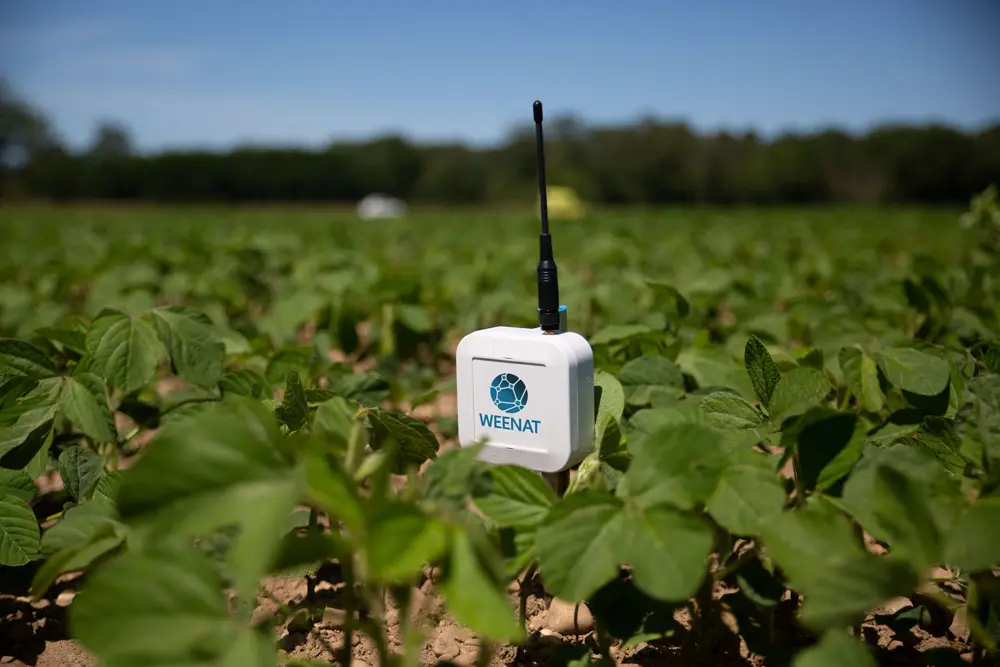

Made in France

Easy maintenance

Resistant battery

Integrated GPS tracker

2-year warranty

Request your free online quote or contact us directly 👇
Free quote with no obligation
All your agro-weather data on a single application
With Weenat, enjoy unique features to manage your irrigation. Take your data everywhere with you and monitor your plots 24/7 from your computer, tablet, or smartphone.
Plan your watering rounds
Your time is precious. Thanks to data from your probes and 15-day weather forecasts, you avoid unnecessary trips to your plots.
Make the right decisions
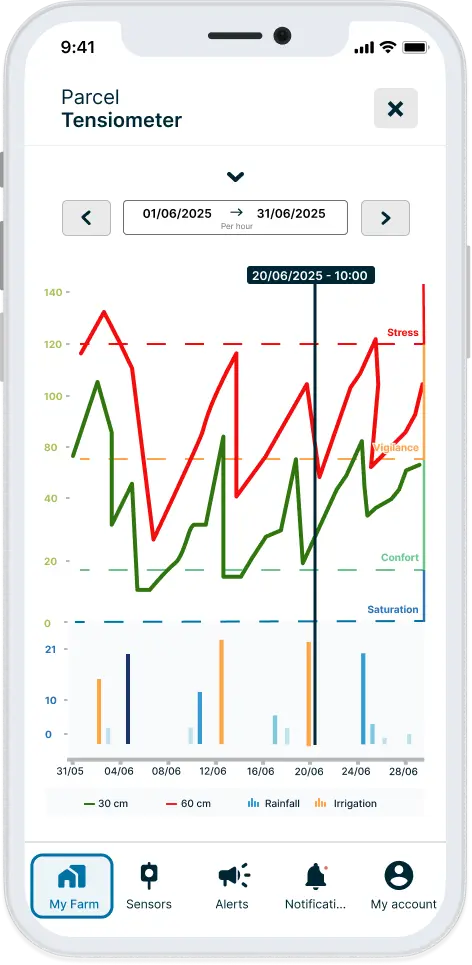
With Weenat, you know exactly when your plants need water. Based on data from your probes and your soil type, the application tells you whether you’re in a situation of saturation, comfort, vigilance, or stress.
And say goodbye to water stress!
Thanks to alerts, you’re notified when water availability at a horizon changes threshold. You can then react as quickly as possible to avoid water stress.
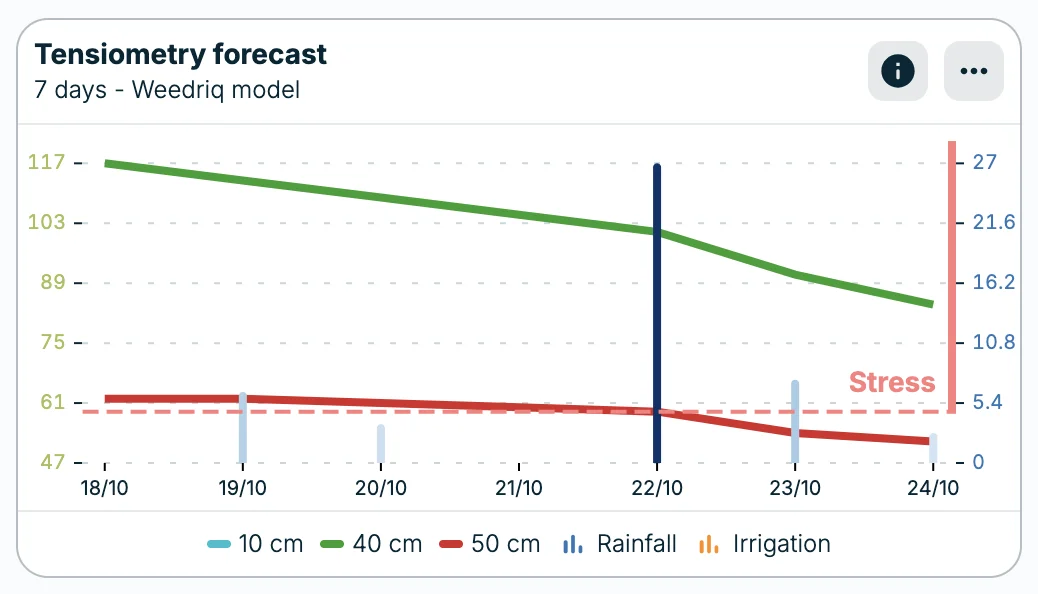
Weedriq, the tool to forecast available soil water at D+7
Weedriq combines historical and real-time information from Weenat tensiometric probes with local weather forecasts to simulate, at D+7, the evolution of tensiometry, that is, the force roots need to extract water from the soil.
You can thus anticipate your irrigation much more easily!

More than 40,000 farmers trust us
Discover their story ⤵️

“Weenat probes allowed me to save water and better understand plant water needs”
Anthony Oboussier
Arborist in Drôme, France
To go further
What weather parameters are measured by the tensiometric probe?
The Weenat connected tensiometer is equipped with a Watermark tensiometric probe and a soil thermometer to monitor in real time the variations in your plot’s soil.
If you wish to monitor other agro-weather parameters on your plots, the tensiometric probes can be coupled with one or more other Weenat sensors, such as the rain gauge, anemometer, capacitive probe, frost sensor, or leaf wetness sensor.
How much does the Weenat tensiometric kit cost?
The Weenat tensiometric kit consists of 3 connected tensiometers from 15 to 30 cm and 3 connected tensiometers from 30 to 60 cm. To know the sale price of the tensiometric kit, request an online quote.
All data from your tensiometer kit is accessible on the Weenat application, thanks to the Weenat Expert subscription.
Which subscription should I choose to access my tensiometer data?
All data (real-time and historical) from your tensiometer kit is accessible on the Weenat application, thanks to the Weenat Expert subscription.
How the Weenat tensiometer probe works
What are the differences between Weenat tensiometers and wired tensiometers?
The connected Weenat solution simplifies the irrigator’s work by automating soil water tension readings via connected sensors. We gather the collected data and have set up alerts and decision support tools on a web and mobile application.
Comparison between the cost of using Weenat connected probes and that of wired probes: (X minutes/day for travel + X minutes/day for reading + X minutes/day for interpretation) x number of days = a lot of money, comfort, and reactivity.
What is the measurement precision?
The reliability of the tensiometric probe measurement is more dependent on installation quality and proper choice of installation area than on the sensor itself. It’s rare for two tensiometers to measure exactly the same thing, especially when the soil is dry.
However, it’s not the sensor’s precision that will impact irrigation management quality; it’s the evolution of tension relative to dry and wet reference levels that matters more than a one-time measurement.
Tensiometry (kPa)
Measurement principle: Electrical resistance
Measurement range: 1 to 200 kPa
Measurement depth in soil:
- 3 sensors from 15 to 30 cm
- 3 sensors from 30 to 60 cm
Soil temperature (°C)
Measurement principle: Electrical resistance
Measurement range: -40°C to 125°C
Measurement depth in soil:
- 3 sensors from 15 to 30 cm
- 3 sensors from 30 to 60 cm
Precision: Plus or minus 0.2°C

How does the tensiometric probe work?
A tensiometer is a tool for measuring soil matric water potential.
Unlike volumetric humidity (percentage of water in soil) measured with a capacitive sensor, matric water potential translates the force with which water is retained in the soil and therefore the force that must be applied to a volume of water to extract a certain quantity of free water. It’s generally expressed in pressure units (kPa, cbar, or hydraulic head) and is commonly called suction.
Today, tensiometric probes used in agriculture are electric; old tensiometers were composed of a manometer to read a measurement directly in the field. They’re no longer really used because they were more tedious to install, more sensitive, and required going to the field to read the measurement. However, the operating principle remains the same.
A tensiometric probe is composed of a porous sensor permeable to water; the latter will more or less fill with water until a pressure equilibrium is created between the soil and the tensiometric probe. The quantity of water absorbed by the tensiometer will represent the tension (or suction) measurement. For the Watermark probe (used in Weenat tensiometers), two electrodes measure the resistance that translates this water quantity.
What is the difference between tensiometers and capacitive probes?
| Type of agricultural probe | Tensiometric probe | Capacitive probe |
|---|---|---|
| Measurements | Measurement of water tension in soil (kPa) | Measurement of soil volumetric humidity (%) |
| Direct translation of plant water stress | Measurement of water volume in soil without considering its availability for the plant | |
| Continuous measurements | Continuous measurements | |
| Small measured volume (few centimeters around sensor) | Small measured volume (few centimeters around sensor) | |
| Method compatible with IRRINOV® reference thresholds for potato and corn | Limited measurement ranges and therefore sometimes poorly suited to restrictive irrigation management at high tension | |
| Use | 3 probes at 30 cm and 3 probes at 60 cm for each plot or per soil type | 1 probe per plot or per soil type |
| Measurement interpretation requires technical expertise | Measurement interpretation requires technical expertise | |
| No calibration and little maintenance necessary | Calibration necessary to precisely measure soil humidity |
Tensiometer installation
How to install your connected tensiometer?
The quality of a tensiometer installation is essential to obtain a good measurement. The installation objective is to have good contact between the soil and the probe, and to ensure this contact is durable during the season (be careful for clay soils when they dry out; the probe can detach from the soil, for example).
The explanations below are summarized in this video.
Where to install your sensor?
Different rules exist to guide the choice of tensiometer installation area, but there’s no miracle answer, and tensiometer installation must be reasoned according to soil, crop in place, and irrigation method.
Homogeneous soil type
Sensors must be installed in homogeneous soil. Triggering irrigation or modifying irrigation frequency is mainly justified by a change in tension evolution (water availability decreases less rapidly than expected, for example). However, tension evolution depends directly on soil type and structure. To be able to make a decision and not distort the median, different measurement points must be distributed over the same soil type to be able to compare it and determine an irrigation strategy.
This homogeneous soil zone may be only a small part of the plot and is not necessarily the most representative zone of the plot; it may be the most drying zone, for example.
Representative vegetation
Tensiometric probes must be installed in an area where the crop is homogeneous and representative of the plot: species, vegetation state, crop stage, density, health status… Be careful during installation not to disturb the crop in place, which would risk altering the representativeness of the measured area.
A representative irrigation area
The monitored area must be representative of the rest of the irrigated plots. Choose an average irrigation area, that is, an area of average rainfall on the farm, or the area that will receive the average dose delivered by the installation.
Tensiometer distribution
It’s preferable to equip a single plot deemed representative and extrapolate the results to the rest of the farm based on the operator’s knowledge of their operation.
Multiplying measurement points is important to have good representativeness of water availability in measured areas. It’s generally accepted that 6 measurement points, distributed in 6, 3, or 2 sites (depending on irrigation method) allow good irrigation monitoring.
In the case of sprinkler irrigation, it’s interesting to have measurements at two different depths minimum. Tensiometric probes can be distributed over 3 measurement sites with two different depths or two measurement sites with three different depths.
With drip irrigation, it’s not necessary to measure at two different depths. It’s mandatory to have at least 3 measurement sites because with 1 or 2 measurement sites, it’s impossible to decide in case of divergence.
At what depth to install your tensiometric probe?
The installation depth of tensiometric probes depends on the crop, but also on soil depth, and depending on irrigation type, it may be necessary to measure several horizons.
Installing tensiometers when drip irrigating
For drip irrigation, it’s not necessary to measure different horizons and you can be satisfied with installing tensiometers at a single depth. The objective is to measure tension at the periphery of the dripper’s influence zone (also called wet bulb) in the root system and ensure this tension remains more or less stable during the season. Depending on soil type, it may be important to install an agricultural tensiometer deeper to ensure water diffuses properly.
Installing tensiometers for sprinkler irrigation
In the case of sprinkler irrigation, the objective is to ensure that the applied dose recharges the soil with water for the duration of the watering round, so it’s necessary to measure different depths to ensure the soil recharges sufficiently with water during irrigation and that this applied water dose is properly used.
Weenat tensiometers come in two different sizes: 15-30 cm and 30-60 cm. The advantage of these dimensions is to be able to install devices both in the roots between 15 cm and 30 cm as well as deeper probes to monitor the evolution of water availability in the following horizons up to 60 cm.
Irrigation probe maintenance
How to maintain your agricultural tensiometer?
To guarantee the precision of your tensiometric probe over the long term, a few simple maintenance gestures are enough:
- Check the proper positioning of the antenna: it must be vertical and properly screwed.
- Check the housing integrity: it must be perfectly intact and properly closed.
- The sensor must be properly inserted into the soil (use the marks present on the rod). A crack in the soil around the tensiometric probe can generate measurement errors: it’s then necessary to remove it from the soil before reinstalling it nearby.
The lifespan of your sensors can also be extended by winterizing them when the irrigation season is over.
- Remove the tensiometers from the ground carefully when the soil is moist: just after the last irrigation of the season or after intensive watering around the sensor.
- Using a sponge or damp cloth, remove the soil present on the soil temperature and tensiometry probes.
- To finish cleaning the tensiometric probe, immerse it in water then remove soil residue using a sponge without using the abrasive side.
- Water may have accumulated in the sensor rod: empty it before storage.
- Store your sensors horizontally in a dry place sheltered from frost and dust.

Do you have a question about the tensiometer or Weenat application?
Send us a message via the form below. Our experts respond within 48 hours.
Made in France

reliability and robustness
2-YEAR WARRANTY

CUSTOMER SUPPORT AT YOUR SERVICE